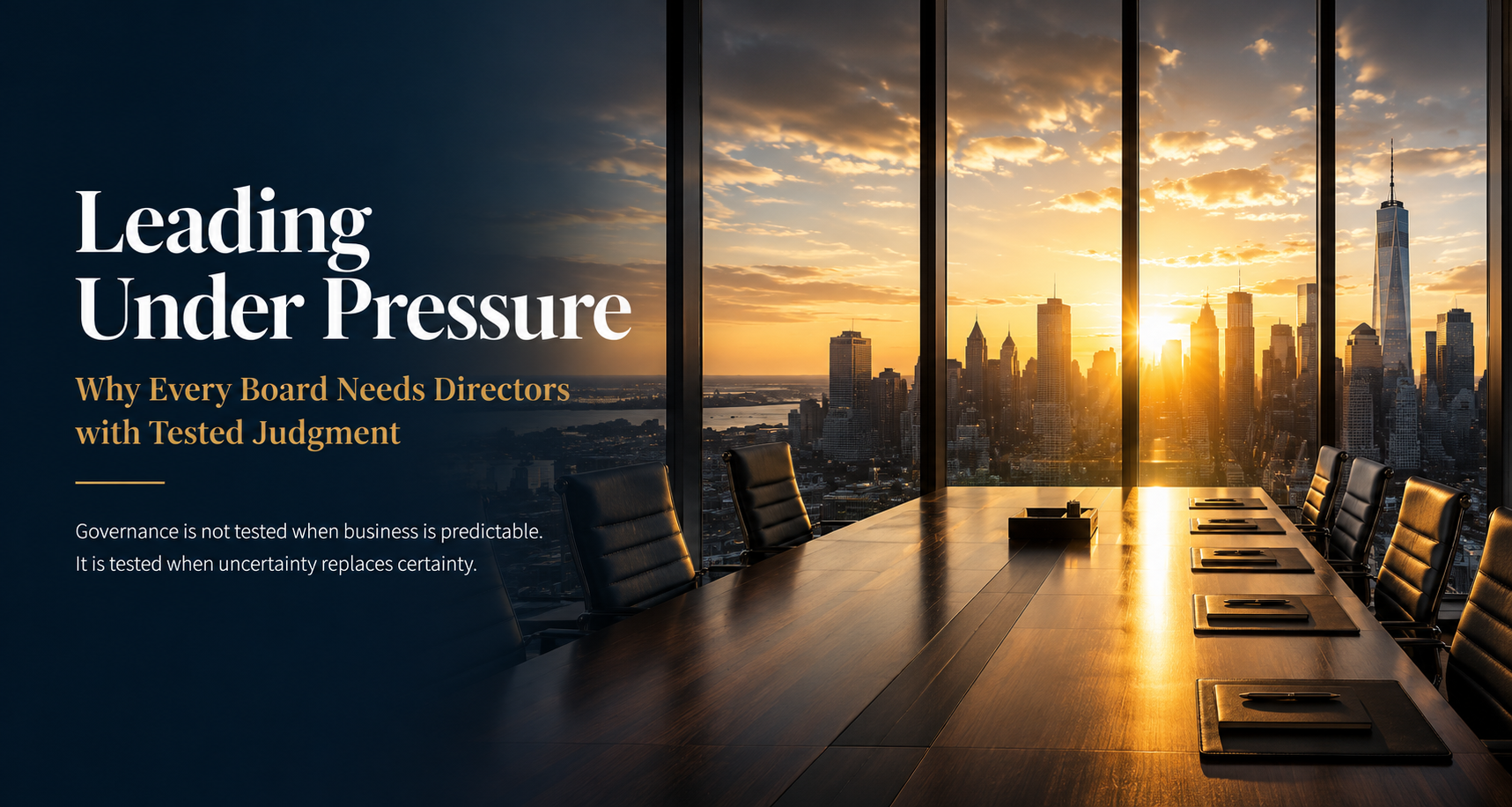
Leading Under Pressure
By Ken Tays, NACD.DC
A Boardroom Perspective
Boards are often evaluated by the decisions they make when business is thriving. Yet the true measure of governance is revealed when certainty disappears, information is incomplete, and every available option carries consequence. Those moments demand more than experience. They demand judgment that has already been tested.
OVERVIEW
Every board eventually faces a moment when there are no easy answers.
Markets shift. A cybersecurity incident unfolds. A key executive resigns unexpectedly. A regulatory investigation begins. A once-reliable strategy stops producing results. In those moments, the quality of governance is measured not by the decisions made when conditions are favorable, but by the judgment exercised when uncertainty is at its highest.
Over the course of my career, I have learned that pressure has a way of revealing character. As a non-commissioned officer in the U.S. Army, I learned that leaders cannot allow fear or confusion to dictate their actions. Years later, as a federal bank examiner during the financial crisis, I sat across from directors and executives as we confronted difficult realities about the condition of their institutions. Those conversations were not theoretical exercises in governance. They involved livelihoods, communities, shareholder value, and the future of organizations that had been trusted for generations.
Those experiences taught me a lesson that has shaped my view of board service: governance is not tested when business is predictable. It is tested when the facts are incomplete, the consequences are significant, and every available option carries risk.
Today's boards operate in an environment defined by rapid technological change, geopolitical instability, cyber threats, evolving regulation, and increasing stakeholder expectations. Technical expertise remains essential, but experience alone is not enough. Boards need directors who can remain objective under pressure, ask difficult questions without becoming adversarial, and make sound judgments when certainty is impossible.
Governance is easy when conditions are stable. It proves its value when uncertainty replaces certainty. In those moments, tested judgment becomes a board's greatest asset.
The strongest boards are distinguished not by how often they agree, but by how effectively they navigate uncertainty together. They foster constructive debate, challenge assumptions, and ensure that difficult conversations happen before circumstances force them.
For aspiring and experienced directors alike, this raises an important question: What qualities should boards value most in an era where disruption has become the norm? I believe the answer begins with tested judgment, the kind that can only be developed by leading through adversity.
TRUTH BEFORE CONSENSUS
Consensus is not the objective of good governance. Sound judgment is. Consensus is valuable only when it is the product of rigorous discussion rather than the absence of disagreement. Seeking truth before consensus produces better judgment.
When boards reach agreement before the difficult questions have been asked, consensus can create a false sense of confidence. Decisions made too quickly often rest on assumptions that have not been tested, risks that have not been fully explored, or perspectives that have not yet been heard. Such consensus is fragile because it has not been challenged.
By contrast, consensus that emerges after thoughtful debate is far more resilient. Directors who respectfully question assumptions, examine contrary evidence, and encourage differing viewpoints strengthen the quality of the board's decisions. When every voice has been heard and every significant issue has been explored, agreement reflects confidence rather than convenience.
The board's first responsibility is not to reach agreement. It is to develop a shared understanding of the facts. Only then can consensus become a sign of sound governance rather than a substitute for it.
EXERCISE INDEPENDENT JUDGMENT
One of the greatest responsibilities of a director is to exercise independent judgment. Independence is more than meeting regulatory standards or satisfying exchange listing requirements. It is a mindset—one that requires the courage to think critically, ask difficult questions, and evaluate issues based on facts rather than assumptions or consensus.
Strong boards do not exist because every director sees an issue the same way. They are effective because directors bring diverse experiences and perspectives to the discussion, challenge one another respectfully, and ultimately arrive at better-informed decisions. Constructive disagreement is not a sign of dysfunction; it is evidence that the board is fulfilling its oversight responsibilities.
Throughout my career, I learned that some of the most significant risks were not hidden in the data—they were hidden in assumptions that had gone unchallenged. Whether evaluating a strategic initiative, a major investment, or an emerging risk, directors should be willing to ask, "What evidence supports this conclusion?" Equally important is the follow-up question: "What evidence might suggest we are wrong?"
Independent judgment is the discipline to think for yourself while deciding for the organization.
LEAD WITH COURAGE AND COMPOSURE
Every director hopes they never have to govern through a crisis. The reality is that every board eventually will.
A cybersecurity breach. A product failure. A regulatory action. A liquidity event. The specific circumstances may differ, but the challenge is the same: making sound decisions when the facts are incomplete, the pressure is intense, and every option carries meaningful consequences. Courage allows sound judgment to survive when pressure tempts people to abandon it.
Long before I served in boardrooms, I learned this lesson as a non-commissioned officer in the U.S. Army during combat deployments. In high-pressure environments, leaders quickly discover that courage is often misunderstood. Courage is not the absence of fear, nor is it acting impulsively. Courage is the discipline to remain composed, assess the situation objectively, and make the best decision possible despite uncertainty.
That lesson has stayed with me throughout my career. Whether leading soldiers, examining financial institutions during the financial crisis, or overseeing complex business operations, I found that pressure does not create character—it reveals it. It exposes whether leaders can separate facts from emotion, remain focused on the mission, and inspire confidence when those around them are looking for direction.
Leading with courage does not mean having all the answers. It means asking the difficult questions when others are reluctant to do so. It means making decisions grounded in evidence rather than emotion. It means resisting the temptation to act simply because action feels preferable to patience. Most importantly, it means keeping the organization's long-term interests in focus, even when short-term pressures dominate the conversation.
Composure is contagious. When directors remain calm, objective, and disciplined, they create an environment where better decisions can emerge. That is when a board delivers its greatest value—not because it can eliminate uncertainty, but because it can lead effectively through it.
The board earns its place not by eliminating uncertainty, but by bringing clarity and composure to it.
THINK LIKE A STEWARD
Throughout my career, I've learned that very few meaningful accomplishments happen overnight. Whether developing leaders, building strong organizations, restoring troubled institutions, or earning trust, lasting success is almost always the product of consistent decisions made over time. The long road is rarely the easiest path, but it is often the one that creates the strongest foundation.
That perspective has shaped how I think about governance. Every significant board decision should be evaluated not only by its immediate impact, but also by the legacy it leaves behind. Will this decision strengthen the organization's culture? Will it improve its ability to withstand future challenges? Will it position the company to create value five or ten years from now? These are the questions of stewardship and stewardship extends judgment beyond today's results.
Stewardship also requires discipline. There will always be opportunities to pursue quick wins, delay difficult investments, or shift risk into the future. Effective directors recognize that these choices often produce short-term benefits at the expense of long-term resilience. Their responsibility is not to maximize today's performance at tomorrow's expense, but to ensure the organization is stronger because of the decisions made today.
Ultimately, directors are not simply overseeing a business; they are safeguarding an institution. They inherit the work of those who came before them and bear the responsibility of leaving the organization stronger for those who follow.
A director's tenure is temporary. The impact of a director's decisions is not.
BUILD TRUST THROUGH CANDOR
Trust creates the environment where judgment can be exercised honestly. Like a reputation, it is earned slowly through consistent actions and can be lost in a single moment. Without trust, even the most talented board struggles to have honest conversations. With trust, directors can challenge one another, debate difficult issues, and ultimately make better decisions.
Trust does not require agreement. In fact, some of the strongest board relationships are built through respectful disagreement. What matters is that every director believes the discussion is motivated by a common purpose: advancing the long-term interests of the organization.
Throughout my career, I have come to believe that people will accept difficult messages—even those they strongly disagree with—if they believe your motives are genuine. When colleagues know that your questions, concerns, and recommendations are driven by what is best for the organization rather than personal agendas or individual recognition, trust begins to take root.
That conviction has shaped my own leadership philosophy. I have always tried to be direct, candid, and transparent. Sometimes that means delivering news people would rather not hear or asking questions others are reluctant to ask. Candor is not always comfortable, but avoiding difficult conversations rarely serves the organization. The responsibility of a director is not to preserve comfort; it is to preserve the integrity and long-term success of the enterprise.
Candor, however, must always be accompanied by respect. The goal is never to win an argument or prove someone wrong. It is to ensure that important issues are fully understood before important decisions are made. Honest, evidence-based dialogue creates an environment where ideas are tested, assumptions are challenged, and trust grows because everyone knows the discussion is grounded in the organization's best interests.
Trust is not built because directors always agree. It is built because no one questions their commitment to the organization's best interests.
HABITS OF TESTED JUDGMENT
Principles matter only if they influence behavior. Directors who consistently demonstrate sound judgment under pressure tend to share several habits:
• They seek evidence before reaching conclusions.
• They ask questions before offering opinions.
• They challenge assumptions without challenging people.
• They remain calm when others become emotional.
• They never confuse oversight with management.
Throughout my career, I've discovered that the quality of a leader is often reflected in the questions they ask rather than the answers they give. The same is true in the boardroom.
QUESTIONS FOR THE BOARDROOM
Take these questions into your next board meeting. Don't rush to answer them. Listen to the discussion they create.
1. What assumptions are we making that have not been challenged?
2. What evidence would cause us to change our position?
3. Are we discussing today's problem or preparing for tomorrow's risk?
4. Have we encouraged genuine debate, or simply reached consensus?
5. If this decision were reported on the front page tomorrow, would we be confident in both the outcome and the process?
Every board will eventually face a decision where the facts are incomplete, the risks are significant, and the pressure is immense. In those moments, policies won't make the difference. Experience alone won't make the difference. Tested judgment will.
That is why leadership under pressure matters.
And that is why boards need directors whose judgment has already been tested.