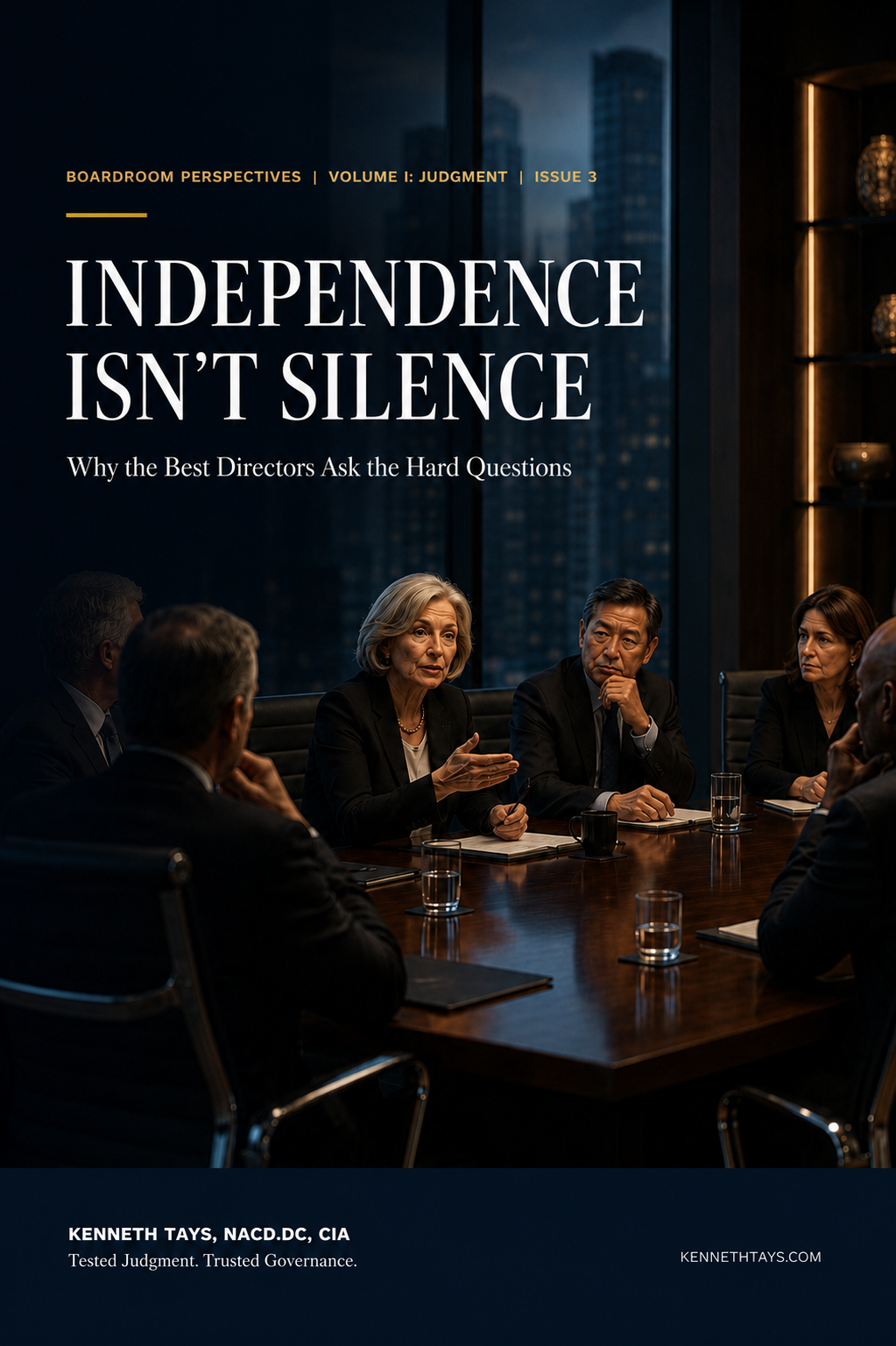
The most consequential boardroom failures do not always begin with a bad decision. Sometimes, they begin with a question that was never asked.
During my 12 years as a federal banking regulator, I met with dozens of bank boards. I also reviewed years of board and committee minutes as part of the examination process.
Those minutes often revealed which directors were shaping the discussion. They showed what the board considered important, how it responded to management, and whether directors were examining the institution's risks or merely receiving information about them.
The most influential directors were rarely preoccupied with low-level operational matters. Their questions brought the discussion back to risk, strategy, and consequences. They wanted to understand the assumptions behind management's recommendations and what could happen if those assumptions proved wrong.
When an institution was struggling, its minutes sometimes raised a revealing question: Had the board challenged the decisions that contributed to the problem, or had the risks reached the boardroom only after the consequences became unavoidable?
Board engagement was never the only factor affecting performance, but the pattern was difficult to ignore. Institutions with engaged boards were generally better positioned to identify problems, test management's response, and act before weaknesses became crises.
Board sophistication did not necessarily correspond to the size of the bank. Some larger institutions had accomplished directors but boards that were less connected and more dependent on management. Some smaller banks had directors with less prestigious credentials, yet their boards were cohesive, informed, and actively engaged.
Independence Is a Behavior
Corporate governance standards generally define independence through a director's relationships with the company. Financial, professional, and personal ties are examined to determine whether they could compromise objectivity.
These safeguards establish whether a director is structurally independent. They cannot tell us whether that director will exercise independent judgment.
A director can satisfy every formal requirement and still become overly deferential to management, reluctant to disrupt consensus, or unwilling to challenge an influential colleague. Independence on paper does not guarantee independence in the boardroom.
Behavioral independence becomes visible when circumstances are uncertain. It appears when a director examines an assumption others have accepted, requests evidence behind a confident conclusion, or slows a decision until its potential consequences are understood.
This does not require reflexive opposition. Directors who challenge every recommendation can be as ineffective as those who challenge none. Independent directors listen, assess the evidence, and recognize when an issue requires deeper examination.
Why Capable Directors Remain Silent
Silence does not always reflect disengagement. Capable directors can remain quiet for reasons that seem reasonable.
Management knows the business better. No one else appears concerned. Another question could delay an important decision. A director may sense that something is wrong but lack enough information to explain the concern with confidence.
This creates one of the boardroom's more dangerous dynamics: silence becomes self-reinforcing.
Directors remain quiet because others appear unconcerned. Others appear unconcerned because no director has spoken. Management interprets the absence of questions as support, and the chair concludes that the board is ready to decide.
What looks like consensus may be a collection of unexpressed doubts.
Directors do not need to possess the answer before raising a concern. Some of the most valuable questions begin with a simple admission: “I may be missing something, but help me understand...”
That question creates room to examine an issue before uncertainty is converted into a decision. A director's responsibility is not to speak only when certain. It is to recognize when uncertainty deserves the board's attention.
The Questions That Reveal Judgment
The quality of board engagement cannot be measured by the number of questions directors ask. Activity and contribution are not the same.
The strongest directors I observed did not use board meetings to manage the institution. They understood the boundary between management and oversight. Their questions focused on matters that could materially affect the bank.
What assumptions must hold true for this strategy to succeed?
What risks are we accepting?
What are the consequences if management's projections are wrong?
Which alternatives were considered?
What information would cause us to reconsider?
These questions test whether a recommendation is supported by sufficient evidence and whether the board understands the risks it is being asked to accept.
Timing matters. As a board moves toward consensus, directors become less willing to reopen the discussion. Time and money may already have been invested. Eventually, preserving momentum can feel more important than examining uncertainty.
The best questions are asked before the organization becomes committed to the answer.
Constructive challenge protects the quality of the decision. It allows management to test its reasoning, obtain more information, or modify a recommendation before changing direction becomes costly.
Culture Determines Whether Judgment Is Heard
Directors quickly learn how candor is received. They notice which concerns are examined, which are dismissed, and whether disagreement carries an unspoken cost.
The differences I observed among boards were not always explained by institutional size or director credentials. Connection mattered.
Some smaller boards had developed strong working relationships. That connection did not eliminate disagreement. It created enough trust for disagreement to occur.
Some larger boards struggled to develop the same cohesion. Their directors could be individually accomplished but collectively distant. Without strong relationships among directors, the board became more dependent on management to frame the issues and guide the discussion.
The lesson was not that smaller boards were inherently more effective. Effectiveness depended on whether directors had enough trust to challenge one another and management without treating disagreement as disloyalty.
The chair plays a defining role. A strong chair invites competing perspectives, prevents dominant voices from controlling the discussion, and ensures that legitimate concerns are examined.
Management also shapes the culture. Executives who respond defensively can teach directors to remain silent. They may overwhelm the board with complexity, dismiss a concern as uninformed, or imply that a director does not understand the business.
Enron provides one of the clearest examples. Its executives cultivated a reputation as the “smartest guys in the room,” while the board relied heavily on management's explanations of complex and risky transactions. A subsequent U.S. Senate investigation found that the board routinely relied on representations from Enron management and Arthur Andersen with little effort to verify the information it received.[1]
When management's confidence becomes a substitute for evidence, directors may mistake deference for sound oversight.
A board should become more skeptical, not less, when management insists that only management can understand the answer.
When management's confidence becomes a substitute for evidence, directors may mistake deference for sound oversight.
A board should become more skeptical, not less, when management insists that only management can understand the answer.
Executives who acknowledge uncertainty and engage concerns openly create a different environment. They recognize that difficult questions are part of the board's responsibility.
Candor does not weaken trust. On effective boards, candor is evidence that trust exists.
Independence Must Be Exercised
The duty to ask difficult questions is more than a matter of boardroom style. It is part of the director's responsibility to make an informed decision.
Smith v. Van Gorkom remains a defining illustration. The Delaware Supreme Court found that Trans Union's directors breached their duty of care by approving a merger without adequately informing themselves about the transaction. The central issue was not director misconduct or an unfavorable outcome. It was whether the board had followed an adequately informed process.[2]
Directors are not expected to predict every outcome or prevent every loss. They are expected to deliberate, examine the information reasonably available to them, and understand the basis for the decisions they approve.
Independent judgment is demonstrated by insisting that the board has enough information to make a decision it can responsibly defend.
Long after a meeting ends, its minutes may become the record of that oversight. They may show the reports the board received and the decisions it approved. The real test occurs earlier, when a director recognizes that the discussion is incomplete, management's confidence is not supported by the evidence, or the board is moving toward agreement too quickly.
At that moment, the director must decide whether to speak.
The best directors do not challenge management to demonstrate their independence. They ask difficult questions because the organization needs the answer.
Questions for the Boardroom
QUESTION 11 | INDEPENDENCE IN PRACTICE
Do our directors demonstrate independence through their behavior, or only satisfy its formal definition?
QUESTION 12 | THE MEANING OF SILENCE
When no one raises a concern, how do we know whether the board truly agrees?
QUESTION 13 | QUESTIONS THAT MATTER
Are our directors focused on the risks, assumptions, and strategic consequences that could materially affect the organization?
QUESTION 14 | TESTING CONSENSUS
Do we invite competing perspectives before consensus becomes difficult to reconsider?
QUESTION 15 | A CULTURE OF CANDOR
Does our boardroom culture, including the way management responds, make it safe for directors to ask the questions others may prefer to avoid?
Sources
[1] U.S. Senate Permanent Subcommittee on Investigations, The Role of the Board of Directors in Enron's Collapse. https://www.govinfo.gov/content/pkg/CPRT-107SPRT80393/html/CPRT-107SPRT80393.htm
[2] Smith v. Van Gorkom, 488 A.2d 858 (Del. 1985). https://law.justia.com/cases/delaware/supreme-court/1985/488-a-2d-858-4.html